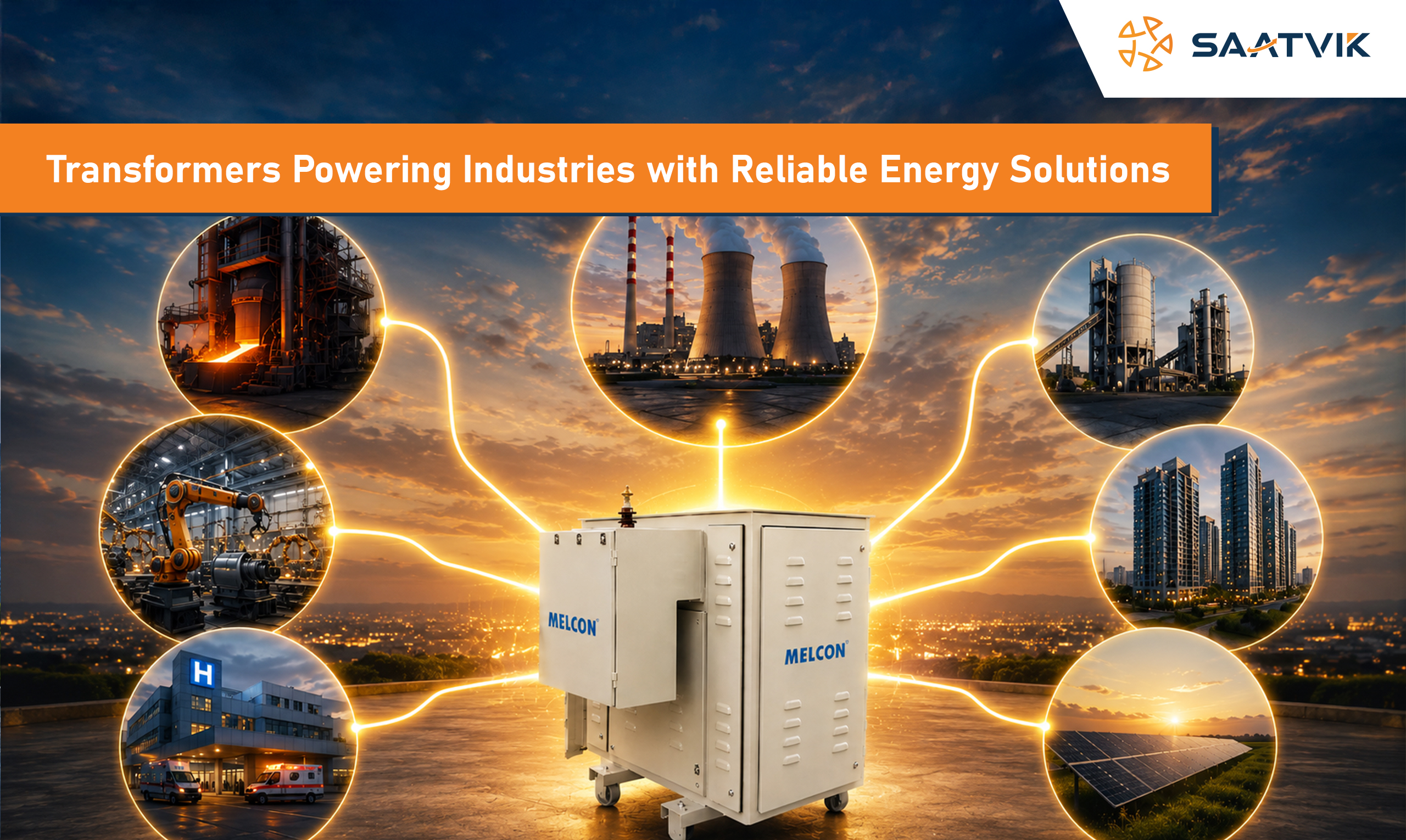
Sectors all over the world are using application-specific power distribution systems to increase safety, efficiency, and dependability in anything from infrastructure projects to commercial complexes and industrial facilities. Selecting the right transformer involves more than just providing energy; it also involves ensuring operational continuity, maximising performance, and building an electrical infrastructure that is ready for the future. A wide variety of transformers, each designed for a particular function and purpose, are essential to heavy industries. The appropriate transformer is essential for supplying power to high-voltage industrial equipment, electric arc furnaces, large motors, drives, and rectifier systems.
Melcon, a prominent power and distribution transformer manufacturing company in India, manufactures oil-type transformers with a power range of 10 MVA to 25 MVA. In the dry-type transformer category, the company produces power ranges from 5 KVA to 2.5 MVA, which have been completed and tested at NABL-accredited laboratories.
Power Transformers, also often known as Oil Type Transformers are designed for applications that need high voltage and capacity, such as Stepping voltage up and down in large power systems. They transport power throughout transmission networks, utility substations at large industrial complexes. Transformers are used to link refineries, mining operations, major industrial manufacturing plants, the steel and aluminium sectors, massive cement companies, thermal and nuclear power plants, and renewable energy projects to the electrical grid. Power transformers uses ONAN, ONAF, OFAF, OFWF cooling methods and generally have a lifespan between 25 to 40 years and are most widely deployed transformers type globally. Core and windings are submerged in dielectric oil that serves as both insulation and coolant, providing superior heat dissipation with thermal conductivity six times greater than air.
While power transformers handle the macro grid, distribution transformers are responsible for the micro level. Both power transformers are classified as Oil Type Transformers and are primarily used at the final stage of electrification distribution, delivering electricity from medium voltage networks to lower voltage levels required by industrial equipment. They are best suited for industrial parks, small-scale factories, warehouses, commercial complexes, and housing societies. Their design prioritises steady voltage control, high efficiency, and dependable performance under changing load situations. Pad-mounted transformers are increasingly being employed in space-constrained metropolitan locations for safe and dependable power delivery. A well-chosen distribution transformer lowers operational expenses by minimising energy loss.
With AI and data centres, cloud computing, and digital infrastructure technologies advancing, the demand for power & distribution transformers has increased across sectors. As these energy-intensive facilities expand, the demand for durable and efficient distribution transformers has increased dramatically to provide continuous power supply, voltage stability, and operational dependability. Industries ranging from industrial plants and commercial complexes to healthcare, telecom, and data centres are expanding their investment in modern oil-type and dry-type transformers to handle increased power loads, enhance energy efficiency, and develop future-proof electrical networks.
Dry type transformers are ideally suited for compact and indoor applications since they may be put immediately within premises, taking up less room and providing enough power for everyday operations. Dry type transformers use air circulation and solid insulating materials like epoxy resin or cast resin to remove any oil-related risks, making them the best choice for indoor and fire-sensitive applications. These dry type transformers are used in a variety of industries, including hospitals and healthcare, commercial retail malls, and high-rise residences. Some of the fundamental advantages of these transformers are that they provide no fire or explosion danger, do not leak oil or pollution, and have a lower overall maintenance cost due to their compact size and light weight, as well as environmental sustainability benefits.
At Melcon each and every transformer undergoes rigorous testing criteria as per the international standards such as IS 2026 for Ratio and polarity test, insulation resistance, no load loss & current, load loss & impedance, IEC 76 for induced over voltage and impulse voltage test & IS 335 for oil BDV Test. Importance of these testing is to ensure that the best quality & power transmission product is delivered to the consumer.
Conclusion
As businesses grow and modernise, the demand for dependable, efficient, and application-specific power distribution has never been higher. Distribution transformers are the backbone of this change, providing safe, steady, and optimised electricity precisely where it is required. Whether it’s tough oil-type transformers for harsh outdoor conditions or energy-efficient dry-type transformers for interior installations, selecting the correct transformer is critical to achieving operational excellence. Investing in the correct distribution transformer is more than just powering equipment; it is about providing industries with increased dependability, efficiency, and long-term growth.