Bygone the times to rely on conventional methods to power your home, business, etc. Solar is free and abundant, and everyone is embracing it for a better future and to save on their electricity bill.
But the point they may feel stuck is:
Which one is better: off-grid, hybrid, or on-grid solar inverter?
It is right; choosing the right solar system can be difficult or require careful consideration, as it is all about making a future-proof investment. On-grid is always a popular choice for homeowners and businesses to capture solar energy and earn credits by feeding surplus power to the grid under the net metering scheme. However, alternatives like off-grid and hybrid inverters are also gaining some traction. In this guide, explore each one of those inverters by seeing their benefits, working, and features. Read the write-up till the end to make a well-informed decision.
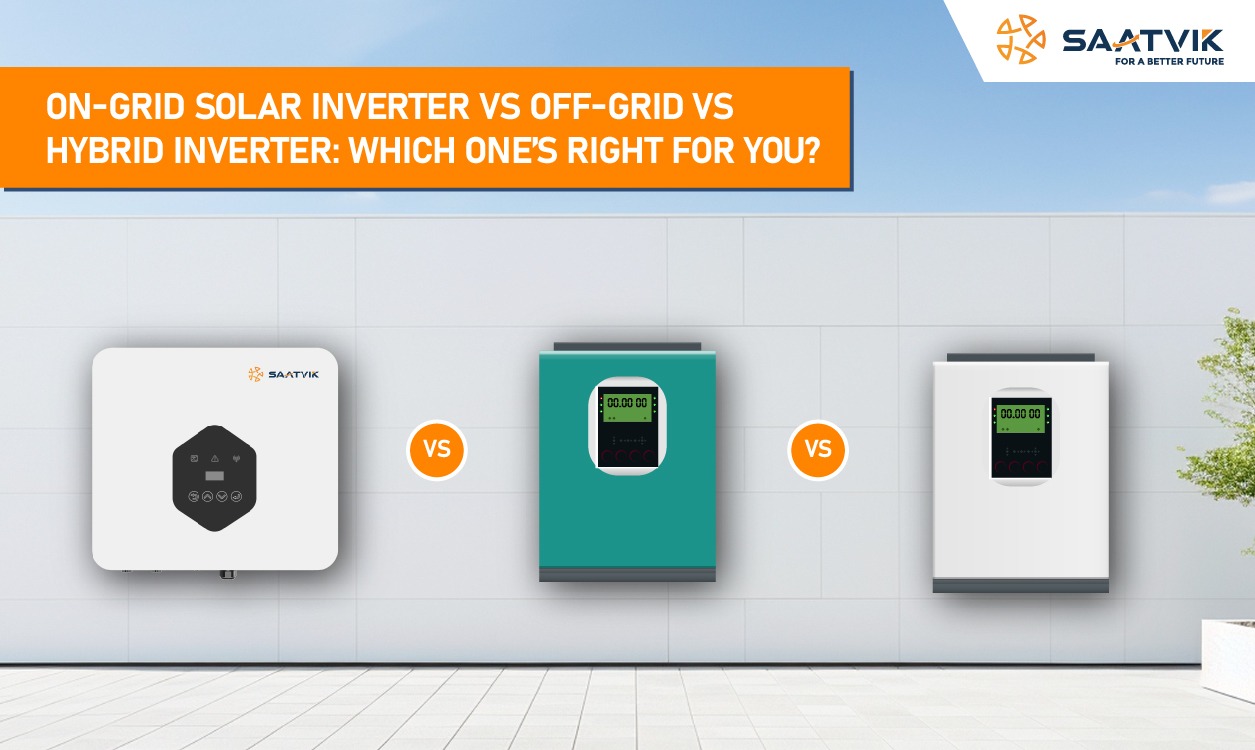
On-Grid Solar Inverter vs Off-Grid vs Hybrid Inverter: A Detailed View
For a better understanding, let’s know each one by one along with their pros and cons.
On-Grid Solar Inverter: An Overview
Also known as a grid-tie solar inverter as it can only generate electricity when it remains connected with the grid. This kind of inverter receive direct current (DC) from solar panels and convert it into alternating current (AC) for usage in home appliances and businesses. But it is necessary for this inverter to replicate the nature of the wave, voltage, and frequency of the grid. Thus, it can only work while having a connection with the grid.
In the situation of power outages or grid unavailability, the solar setup will stop working completely.
During nighttime, energy can be taken from the grid. And when excess energy is generated, it can feed to the grid to earn credits under the net metering scheme.
Advantages of an on-grid solar inverter
- The system is easy to install and maintain
- Surplus energy can’t get wasted as it feeds to the grid or the electricity company.
- It is more economical as there is no need for battery storage.
- During cloudy days or even at night when solar energy doesn’t generate, the grid can supply the power.
Disadvantages of an on-grid solar inverter
- Can’t supply electricity at night as totally dependent on the grid.
- Unable to store electricity
- Doesn’t work during power outages because of anti-islanding protection
Off-Grid Inverter: A Short Brief
The off-grid inverters are fully independent of the grid as they have battery backup. In daytime, the inverter charges the battery and runs the house or business. In Nighttime or power outages, this stored power will get used up.
With this setup, you have the choice either to charge battery by cutting the load or powering the home. This kind of solar installation can benefit the remote or rural areas with frequent power cuts but receive sunlight all year around.
There are times though when the panels generate excess energy more than to charge the battery and run the appliances. In such cases, the surplus energy will go to waste.
Pros of an Off-Grid Inverter
- Makes consumers fully dependent on energy production
- Safeguards houses & businesses from power outages and grid failures
- Permit energy storage that can be used during nighttime
Cons of an off-grid inverter system
- More expensive due to recurring cost of the batteries
- Allows wastage of excess energy
- The system becomes worthless when the power generation through panels are low.
Hybrid Inverter System: A Quick Intro
A hybrid solar inverter setup is relatively new for the solar domain. It is a solar inverter setup that gets connected to the grid and even has battery storage to store excess power.
When the electrical power from the grid is available, it works like an on-grid solar inverter and when power cuts, it’ll work like an off-grid inverter.
The main benefit of using a hybrid inverter setup is the availability of power in all situations. The accumulated power can be used during the night when sunlight is not available. Besides this, when the generation is minimal and the battery is discharged, the power from the grid can work as a backup.
Other merits of the Hybrid Inverter system
- Equipped with load management technology
- No wastage of energy as the surplus feeds back to the grid
- Provides an endless power supply by storing the excess energy in the battery storage
Demerits of using a Hybrid Inverter System
- Higher cost of installation
- High battery cost
- Longer break-even point
On-grid Solar Inverter vs Off-grid vs Hybrid Inverter: In-depth Comparison
To clear out all the confusion between on grid solar inverter, hybrid inverter, and off-grid inverter, here a comparison table is given. Look at the table to see everything in a concise manner for making a better decision for a better future.
| Criteria | On-Grid | Off-Grid | Hybrid inverter |
| Connection with the grid | Yes | No | Yes |
| Battery Backup | No | Yes | Yes |
| Cost | Low | High | High |
| Nighttime | Use Grid | Uses battery | Uses grid & battery both |
| Working during power outages | No | Yes | Yes |
| In matter of low energy generation | Supplements the same through electric utility grid | Unable to charge the battery | Supplements with the help of electric grid |
| In case of surplus energy | Feed back to the grid | All wasted | Feed back to the grid |
| Possibility of earning credit or reducing electricity bill | Yes | No | Yes |
How to pick the best solar inverter for the home?
Here listed the crucial four key factors that you should consider in detail before proceeding ahead to pick one out of off-grid, hybrid, and on-grid solar inverter.
Location
On-grid solar inverter is ideal for places with reliable grids. Whereas off grid works best for the remote places where there is no grid access available. Hybrid inverters are ideal for regions where power outages are common, as they merge a grid connection with a battery.
Budget
Choosing a grid-tie solar inverter will be the most affordable option, offering the quickest payback period with the help of government incentives, net metering, and effortless installation. In contrast, off-grid and hybrid solar inverters still entail higher costs due to the inclusion of battery storage and high-tech inverters.
Backup Power
Homes having a problem with power cutoffs should consider a solar system with a battery to ensure continuous power. On the other hand, a hybrid inverter optimizes solar utilization, providing better control of electricity bills while cutting carbon emissions.
Time of Day (ToD) Tariffs
The emergence of time of day (ToD) tariffs in India promotes efficient energy usage due to different rates based on consumption time. During peak hours with high tariffs, reliance on the grid leads to increased costs. Hybrid inverter, in this case, proves useful as it accumulates energy in the battery during low tariff times and utilize it in peak hours to mitigate the effect of fluctuating tariffs.
Ending Note
All in all, everything comes down to the question again, which one is better: Off-grid, Hybrid inverter, or on-grid solar inverter? The answer lies completely in your reality, needs, and requirements. Explore the options, go through their advantages and disadvantages, and evaluate your needs to choose the ideal one for yourself. In 2025, solar isn’t a luxury anymore; it’s an investment to make your future sustainable and greener.
Made up your mind? Reach out to our certified experts and let the sun power your future.
FAQs (Frequently Asked Questions)
1. Which solar inverter system is ideal for you in 2025 – off grid, hybrid, or on grid solar inverter?
On-grid solar inverter is ideal for the purpose of cost savings through net metering, off-grid settles down at the for places where there is no electricity, and a hybrid inverter offers both savings and backup power.
To save, you can connect with Saatvik Solar to have our grid-tie solar inverter.
2. How to choose the right solar system: On-grid, off-grid, or hybrid?
Before deciding, you should ask yourself these questions.
- How much electricity is accessible in your area?
- What is the cost of residential and commercial electricity?
- How much does your pocket allow you to spend on a solar system?
- How frequent power outages you are facing?
If electricity is good, an on-grid solar inverter is the go-to option. In matters of power outages, choose an off-grid system. Moreover, if you have a substantial budget, always go ahead with a hybrid inverter as it is an amalgam of both on-grid and off-grid.
3. What is the disadvantage of choosing a hybrid inverter system?
The main disadvantages of a hybrid solar inverter system include high initial and long-term maintenance costs, complexity in installation & regulation, and ample space requirements for the battery and inverter.
4. What happens if my solar panels generate more electricity than my usage?
If your solar panel system is generating more electricity than you need, you can feed surplus energy to the grid with the help of an on-grid solar inverter.
In case of needing one, connect with our professionals and get the solar solutions as per your requirements, all under one roof.