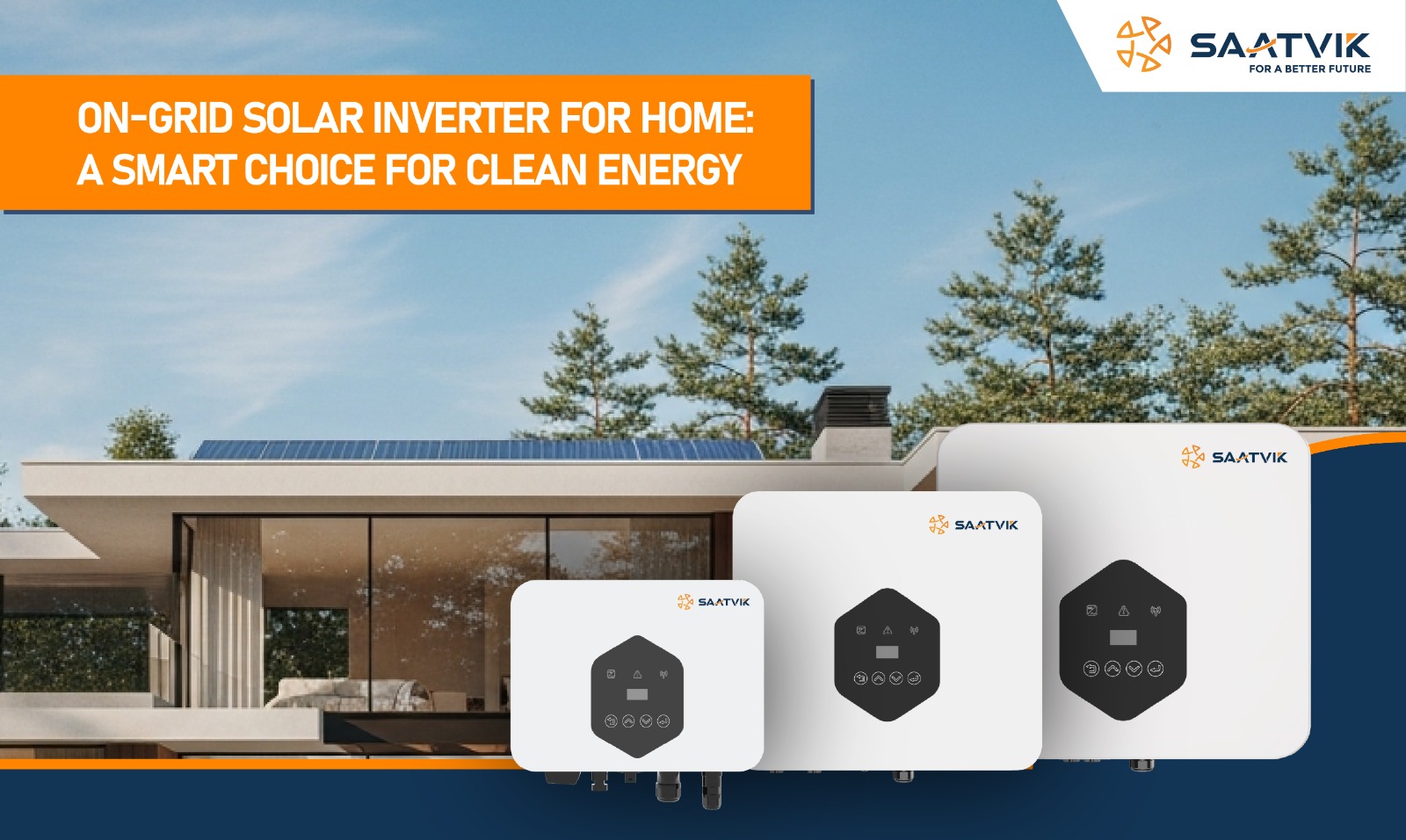
Worried about high electricity bills? Be not anymore, as we understand that it will be a huge burden on your pocket. However, it would be great if you could find a way to save on your bills and contribute to building a sustainable future. Certainly, it is possible with our on-grid solar inverter for the home. Solar panels are the face of solar technology, but the solar inverter is the backbone holding it all together. But what exactly on-grid solar inverter for the home mean, what are its benefits, and how it works.
In this blog, know all such details and things regarding our on-grid solar GTI inverter. Let’s look at on-grid solar inverters and their key components before we proceed with working and the benefits of an on-grid solar inverter for the home.
Grid-Tie Solar Inverter For Home: A Brief Introduction & Components
As it is evident that AC power is necessary for all household equipment, and solar only gives us DC, this creates a demand for an on-grid solar inverter for home. An on-grid solar inverter is commonly called a grid-tied inverter, is a type of solar inverter that is directly connected to the grid. It converts the DC power generated by solar panels into AC power, which is used to run all the household appliances.
The most striking feature of the on-grid solar inverter for home is that these doesn’t require batteries. Instead, they feed excess power to the grid, maintaining a seamless flow of electricity between your home and the utility grid.
Major Components of an On-grid Solar Inverter For Home
Here are the major components that make up an on-grid solar power inverter for home to work smoothly.
1. Solar Panels
Accumulate the sunlight and convert it into DC power.
2. On-Grid Inverter
Converts DC into grid-compatible AC power.
3. Net Meter
Keep track of the electricity used and feed it to the utility grid.
4. Protection Devices
DCDB and SPD (Surge protection device) at the DC side, and ACDB and SPD at the AC side.
On-grid Solar Inverter For Home: How It Works?
Here is the step-by-step explanation showing how a solar inverter works for homes.
First Step: Solar Energy Generation
Solar panels capture sunlight and generate DC electricity.
Second Step: Conversion from DC to AC
The on-grid solar home inverter takes the DC output from the solar panels and converts it into AC power. The converted power is compatible with the local utility grid code.
Third Step: Powering the Load
The converted AC power from the solar inverter for home is used to run household or office appliances. And excess power is fed into the grid through a net meter.
Fourth Step: Net Metering
The net meter keeps a record of the power you generate and how much you feed to the grid. At the end of the billing cycle, the calculation for net value gets done, which is called net metering.
Things to consider before installing an on-grid solar inverter for home
If you are planning to switch to solar to save on your high electricity bills with a solar power inverter for home, consider the following:
Local Grid Availability
Make sure that your areas have a stable grid connection since on-grid solar inverters are completely dependent on it.
Net Metering Policy
Check whether your state’s electricity board supports net metering or not, and what the current ongoing policies and rates are.
System Size
Inspect how much electricity your household consumes monthly. To get this done, you can seek assistance from a top solar manufacturing company like Saatvik Solar.
Ample Roof Space
Enough space on the roof is a mandate to do an effective installation of solar panel systems.
Inverter brand & warranty
Always choose a certified and trusted brand like Saatvik on-grid solar inverter that offers 10 years of warranty, high efficiency, and impeccable after-sales support.
On-grid Solar Inverter For Home: Why are they ideal to use?
It is stated that the on-grid solar inverter is indeed a breakthrough innovation in the solar realm. But why so? Let’s see.
Reasonable Cost-Savings
We all really appreciate it when we save some bucks on something. Isn’t it? An on-grid solar inverter for the home really does that. With the help of net metering, you can send back surplus power to the grid to earn credit or reduce your electricity bill. This way, you can settle down your offset amount in setting up the entire solar ecosystem.
High Scalability
An on-grid solar home inverter can scale and fulfil your energy needs. Thus, no matter if you need it for home or for your business, our GTI solar inverter can cover it effortlessly.
Besides this, you can tailor it as per your requirements.
Economical Maintenance
Saatvik on-grid solar inverters are very low-maintenance. Just clean the panels whenever required to harness maximum power. Moreover, we offer a decent period of warranty (10 years) to ensure that you make the right decision by investing in it.
Eco-friendly
Solar energy is a renewable source of energy. Tapping into it can help you reduce your carbon footprint and create a better future.
With every kilowatt-hour (kWh) produced through solar energy, directly reduce greenhouse gas emissions and dependency on fossil fuels.
Concluding Words!
Whether you are a user of residential needs or with commercial use, the Saatvik Uday Series on-grid solar inverter for home is the right choice for you. Just ensure two main things: that you are living in a grid-connected area and are eligible for net metering. With an on-grid solar inverter, you can save a huge amount on your electricity and can save the world as well by reducing carbon emissions.
Embrace a clean, green, and sustainable future with the smarter choice to eliminate the additional expense of batteries. Switch to Solar. Switch to Saatvik.
FAQs (Frequently Asked Questions)
1. Is an on-grid solar inverter suitable for all applications and places?
It mainly depends on various factors, including grid connection availability, local regulation, and sunlight.
In a place or a location where power outages are common, using a hybrid or off-grid inverter will be a better option than an on-grid solar inverter.
2. On-grid solar inverter or off-grid solar inverter, which one is better?
Both alternatives are good. But their suitability completely depends on various factors like goals, situations, and needs.
If you need savings on your electricity and don’t feel the need for a power backup, going with an on-grid solar inverter is an ideal move for you. On the other hand, if you need backup for power or live in an area where power outages are too frequent, using an on-grid solar inverter is apt in such circumstances.
3. What are the key advantages of an on-grid solar inverter for home?
There are certain advantages that one can enjoy after installing an on-grid solar inverter for home. These are:
- Cost-effectiveness
- Efficient energy usage
- Eco-friendly
- Reduced electricity bills
- Smart & remote monitoring