India’s commercial sector is rapidly shifting towards clean solar energy. Getting commercial solar panels installed at their places gives them an upper hand, with benefits like lower electricity costs, uninterrupted power, and the fulfilment of sustainability goals. From mega factories and warehouses to malls and educational institutions, commercial solar systems are gaining traction as they are confirmed to be long-term savings assets.
However, one questions always remains with people i.e., which one are the best commercial solar panels to use? For this and to bring more clarity, here is a detailed write-up here that can make you reach the point to take the best possible decision.
Commercial Solar Panels System: A Brief Explanation
In comparison to residential installations, commercial solar panel installations are mainly larger setups, designed to fulfil higher and more demanding energy needs.
Several industries are adopting solar panels for their commercial buildings. These are listed here:
- Healthcare & hospitals
- Pharmaceuticals
- Automotive and ancillary units
- Industrial and manufacturing
- Hospitality
- Education & research institutions
- Fast-moving consumer goods (FMCG)
- IT parks and commercial complexes
Basic Components Involved in Commercial Solar Panels Setup
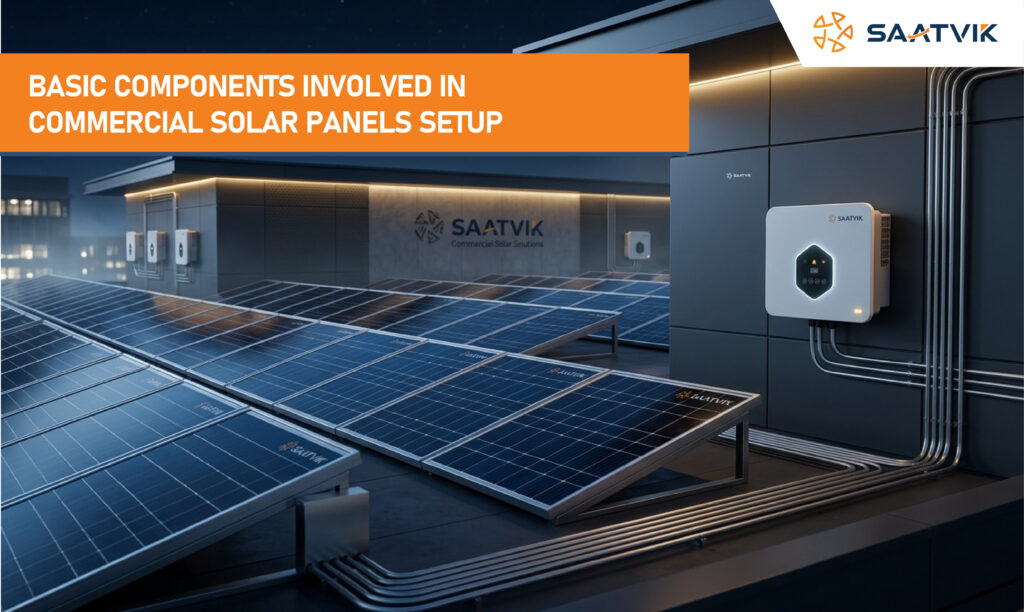
A complete setup of commercial solar panels includes several components. These are:
1. Solar PV Modules
Solar panels for commercial buildings are mounted on the rooftop or the ground. Each panel relates to each other to form a setup that will produce solar energy.
2. Solar Inverters
Inverters are the crucial aspect of commercial solar systems as it converts DC electricity into alternating current (AC), which is needed for the commercial equipment to work.
Common inverters that are mostly used in commercial solar for businesses are:
- On-grid solar inverter
- Micro Inverter
- String Inverter
- Hybrid Inverter
3. Racking & Mounting Structure
Racking and mounting systems are designed to keep the panels intact with the rooftop and the ground. These are useful to:
- Maintain the structural stability
- Set the apt tilt and orientation
- Accommodate site-specific conditions
4. Solar Batteries (Optional)
Batteries with commercial solar panels help in storing excess energy generated to use during the non-generation period or at the time of grid disturbances.
Battery technologies mainly include lithium-ion, lead-acid, or other chemistries based on the applications.
5. Charge Controllers & Meters
Charge controllers in commercial solar systems take care of the energy flow between panels and batteries. On the other hand, meters and monitoring systems track the generation, consumption, and grid interaction.
Cell Technology Comparison for Commercial Solar Panels Installation
The commercial solar panels market will be shaped by four of the cell technologies, i.e., NTOPCon, HJT, PERC, and thin film. Each cell type has its own unique efficiency profile, degradation curve, temperature behaviour, and cost position.
For you all to make the best decision while looking for solar panels for commercial buildings, here is a detailed comparison between these four cell technologies is given. So, kindly take a look before you reach out to the point to make your decision.
| Technology | Efficiency Range | Temperature coefficient | First Year Degradation | Output At 25 years | Typical Cost |
| P-Type PERC | 19.5-21.5% | -035 to -0.40%/°C | 2-3% | 80-83% | Lowest |
| N-Type TOPCon | 21.0-24.8% | -0.29 to -0.32%/°C | 1-2% | 87-90% | Mid |
| N-Type HJT | 21.2-23.6% | -0.24 to -0.27%/° | 0.4-0.5% per year | 90-92% | Mid-High |
| CdTe Thin film | 18.8-19.7% | -0.27 to -0.32%/°C | ~0.3%/yr | ~88% | Mid (per Wp) |
Factors To Choose Commercial Solar Panels for Your Business
Choosing the commercial solar panels only based on price can lead you to face several long-term performance related issues. Businesses must be smart here and should evaluate multiple factors.
1. Solar Panel Efficiency
Efficiency is the rate at which solar PV modules can convert sunlight into electricity.
Higher efficiency means:
- Superior power generation
- Fewer panels needed
- Optimal usage of the rooftop space
For commercial solar panels installation, it is generally advised to use panels with a more than 21% efficiency rate.
2. Temperature Coefficient
India experiences high temperatures in most of the regions. As the temperature rises, solar panels lose efficiency.
So, commercial solar panels that have lower temperature coefficients performs better in the hot climatic conditions.
It is very crucial for places like:
- Delhi NCR
- Rajasthan
- Gujarat
- Maharashtra
- Industrial zones with high heat exposure
3. Commercial Solar Panels Warranty
Commercial solar projects are long-term investments. Thus, be mindful and check for:
- Product warranty
- Performance warranty
- Linear degradation guarantee
Most of the premium commercial solar panel companies offer:
- 12-25 years product warranty
- 25-30 years performance warranty
4. Degradation Rate
Solar panels naturally lose efficiency gradually over time.
All the premium commercial solar panels from top solar panel manufacturers in India like Saatvik Green Energy Limited, degrade more slowly and deliver higher output after 25 years.
A low degradation rate means:
- Enhanced ROI
- Higher lifetime electricity generation
- Consistent business operation
5. Brand Reliability
Commercial solar panels systems demand for bankable and trusted solar brands which have hands-on expertise and experience.
Before choosing anyone for commercial solar systems for your business, consider these factors:
- Manufacturer Reputation
- Service support
- Testing standards
- Certifications
- Financial stability
Benefits of Installing Commercial Solar Panels
Installing commercial solar panels can offer a bag full of long-term advantages.
Cost Management
Generating the energy on-site can help in eliminating the dependence on the grid and save from grid tariffs. Moreover, it supports predictable energy costs in the long run.
Supply Resilience
When a commercial solar panels system relates to storage or grid-connected configurations, solar system can continually provide power even at the times of critical loads.
Scalability
Installing solar panels for commercial buildings gives you the liberty to expand as your energy requirements evolve.
Sustainability Performance
After having commercial solar panels installed at your place, you can reduce reliance on fossil-fuels based electricity and assist in fulfilling the organizational sustainability & ESG goals.
Low Operational Intensity
In commercial solar panels systems, a minimal maintenance requirement will emerge when it designed and operated properly.
Government Incentives & Policy Support Under Commercial Solar Panels System
In India, the central and state agencies, including the MNRE (Ministry of New & Renewable Energy), provide offers and incentives through several policies like net metering, open access, and fiscal incentives that encourage the adoption of commercial solar panels system.
But please note that it all becomes possible based on availability and applicability in that state and project type.
Installation Considerations For Commercial Solar Panels System
Before moving ahead with the installation of solar panels for commercial buildings, businesses must assess:
- Structural stability of the selected rooftop or land
- Availability of the space and shading conditions
- Components quality & supplier credibility
- Regulatory approvals and grid connectivity
- Electrical infrastructure and grid compliance
- Monitoring and maintenance arrangements
Financing Way Out in Commercial Solar Panels System Installation
All the common commercial solar panels installation ways are listed here:
CAPEX
Under this, the business completely owns the solar plant and takes care of all the upfront costs.
OPEX/PPA
In this, a developer comes in the picture who owns the commercial solar panels system and supplies solar power at an agreed tariff.
Net Metering/Open Access
It is all subject to the state policies and regulations.
Tax & Depreciation Benefits
Only where it is applicable under prevailing policies.
Ending Note
Commercial solar panels are increasingly integrated into businesses as they are getting two-way benefits out of them. First is a reduction in their high electricity bills, and second is lowering their carbon footprints. In 2026, choosing commercial solar panels for your buildings isn’t east at all as you need to take several things into consideration for attaining long-term benefits.
It is not the sole duty of the government bodies to look after the future. It is all of us who must shift to solar energy for building a sustainable future.
FAQs (Frequently Asked Questions)
1. How long does a commercial solar panels system last?
Most of the commercial solar panels system last for around 25 to 30 years with minimal regular maintenance and predictive performance.
2. Are commercial solar systems ideal for heavy industrial use?
Certainly, they are designed to fulfil higher energy needs and support manufacturing units, warehouses, processing plants, and other facilities.
3. What is the average payback time for commercial solar panels?
Most commercial solar panels system recover their investments within the span of 3-5 years.
4. Are bifacial solar panels good for commercial solar projects?
Indeed, bifacial solar panels are suitable for industrial and ground-mounted projects because they can generate electricity from both sides.