India is moving ahead, and as it grows, so does the electricity demand. To tackle this, attain net-zero emissions by 2070, and meet climate goals, Solar stands as a pivotal solution.
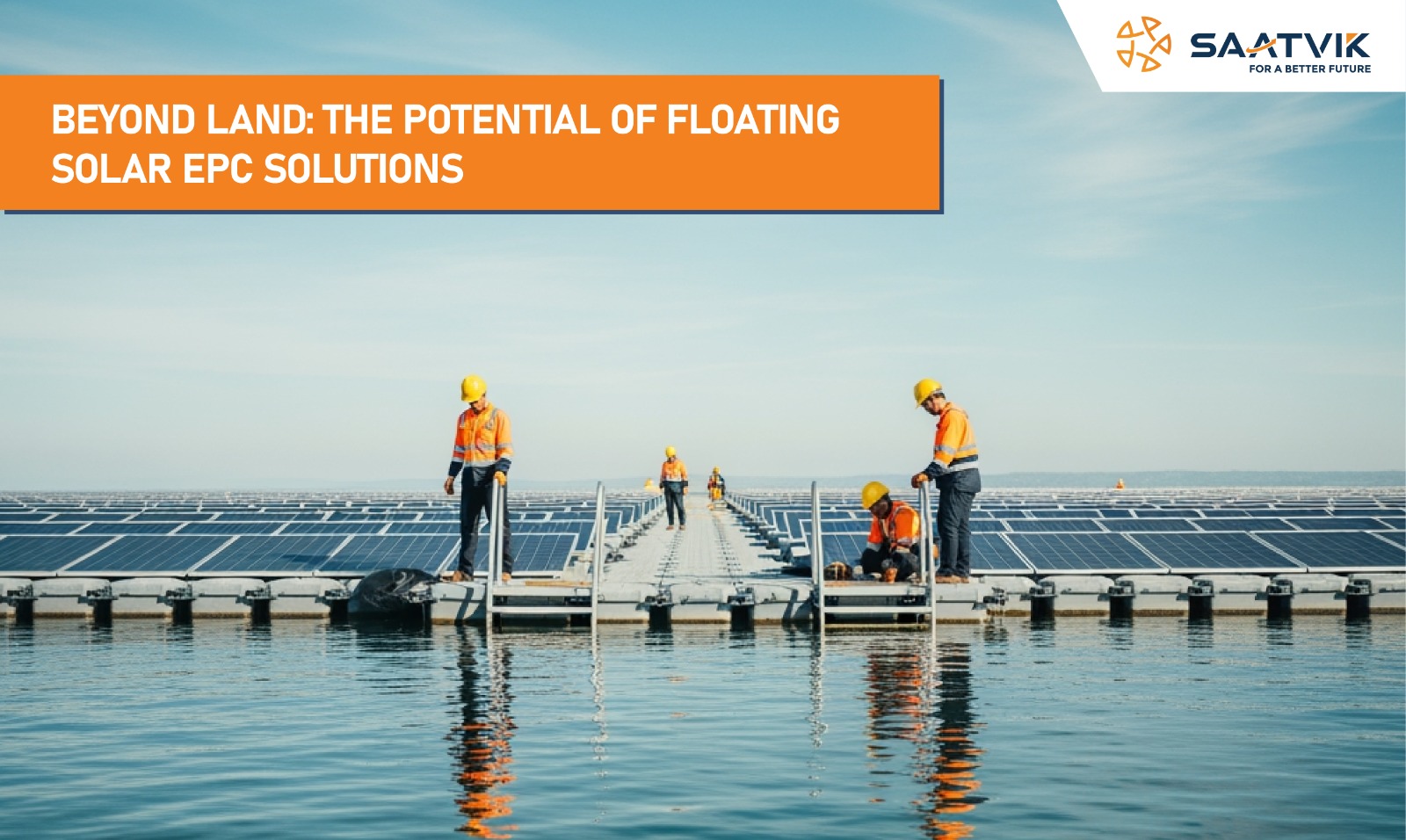
But here comes another challenge: India doesn’t have enough land to support this. Every 1 GW of solar plant requires around 4-5 square km of land, which is not possible in India. Hence, in this picture, Floating Solar EPC solutions emerge as the right fit and are gaining attention in India. It gives you maximum performance while using none of the land, and besides this, it conserves our water bodies as well.
Let’s dive into this a bit deeper to understand floating solar. Go through this article as it delves into the technology, benefits, and challenges of floating solar solutions.
A Short Brief of Floating Solar EPC Solutions
The concept is quite simple. Instead of fixing solar panels into the ground, you mount them on a buoyant platform and leave them on water to float with an anchor system. The solar panels are connected with inverter and an electrical structure on the shore through mooring systems, keeping everything in place. The electricity produced from the solar panels is fed into the grid by the underwater submarine cables.
Primary Components Included in Our Floating Solar EPC Solutions
To understand floating solar better and make the right choice timely, look at the components included in an entire floating solar farm.
Floating Platforms
It is a major part of a floating solar setup made of high-density polyethylene (HDPE) to support panels floating on the surface. Designed to resist corrosion and UV radiation, these platforms can easily tackle the harsh water conditions.
Solar Panels
Convert sunlight into electricity. In the case of floating solar, Panels are coated with a protective layer to secure the same from moisture and humidity.
Mounting Systems
Corrosion-resistant metals are used to attach panels to platforms. These are adjustable to place panels at the right angles for optimal performance and to withstand the movement of water.
Anchoring & Mooring Systems
Anchors, including concrete blocks or helical anchors and mooring lines like cables, chains, etc places the entire structure intact. The selection of both anchoring and mooring systems depends completely on depth, water body, and local environmental conditions.
Electrical Infrastructures
1. Inverters
Choose any from on-grid, central, and string depending on the size of the installation. It converts the panels’ produced DC into AC for the grid or local consumption.
2. Transformers
Infused to step up or step down the voltage of electricity to match the level of the grid or for a storage system.
3. Junction Boxes & Connectors
Securely conjoin everything and distribute the electrical output from various solar panels and inverters.
4. Underwater Cables
Submarine water cables added to transmit electricity from floating platforms to the shore placed system.
5. Monitoring & control systems
Under this comes sensors, data loggers, etc to keep trace of the performance of the solar panels. It provides real-time data, making efficient management and maintenance possible.
Safety & Environmental Protection Equipment
1. Safety Gear
Life jackets, harnesses, and protective clothing comes under this for the safety of the personnel performing installation and maintenance tasks on the water.
2. Environmental Protection Systems
Boom barriers and spill containment equipment to save the surrounding water from any possible contamination during installation.
Benefits of Adopting Our Floating Solar EPC Solutions
Certain advantages will come to you by choosing floating solar for your water bodies, capturing your precious lands. Look and read what those are:
Higher Energy Generation
When placed at a cooler temperature, solar PV panels perform better. The ambient temperature of the water bodies leads to more than 5-10% yield compared to land or ground mounted. With this, you can feed more clean energy to the grid.
Reduces Water Evaporation
The floating EPC solution will cover the area of water that limits the water from evaporating. It is an ideal scenario for all the water-stressed regions where people feel the scarcity of water.
Save Land for Other Purposes
India has limited land availability that is needed for other purposes like infrastructure, agriculture, education, employment, etc. Using it for solar makes no sense. Thus, choosing floating solar EPC here frees that land for other productive usage. In contrary, water bodies are already unusable for any other purpose.
Minimal Ecological Degradation
Floating solar farms have a little adverse effect on environmental conditions in comparison to conventional hydropower dams and reservoirs. It saves water from getting toxic and from growing algae. Moreover, placing floating solar panels leaves a scope for fish and other marine species to have a life over there.
Ease of Deployment
For floating solar EPC solutions, there is no need to perform any major earthwork, cutting the cost and disruption of site preparation.
Floating Solar Solutions: The Challenges Under The Surface
The path to a successful Floating Solar farm isn’t as smooth as it looks. It laid down a series of challenges. These are listed over here:
Surged Upfront Costs
If you are going ahead with a floating solar EPC solution, you need to spend 7-10% more in comparison to ground-mounted. It’s all because of the floating platforms that mainly took around 35% percent of the total floating solar project cost.
Social Impacts
Some of the massive floating solar projects hamper the livelihood of the fishermen. For generations, these people rely on fishing, but can’t access it now.
Apt Skill Shortage
Installing floating solar EPC solutions requires expertise in marine engineering, hydraulics, and float manufacturing, which are still minimally available in India.
Data Gaps
Many of the solar floating farm installations failed or get dropped because of not vividly checked for solar potential, leading to disturb the design and impact assessment.
Floating Solar EPC Solutions: Current Scenario in India
India, as a rich country have a total of 18,000 km2 showcasing a huge potential for floating solar systems installation with an approx. capacity of 280 GW. But only a fraction has been achieved till now. The nation is supporting this through renewable policy, mainly by the Solar Parks Scheme with CFA (Central financial assistance). Several states like Madhya Pradesh, Bihar, Telangana, West Bengal, Andhra Pradesh, Kerala, and Rajasthan have already made significant steps in this.
Glimpse of Major Floating Solar Project (Ongoing & Planned)
Omkareshwar Floating Solar Project (Madhya Pradesh)
India’s largest floating solar plant with 600 MW, with over 2,00,000 high-performing panels and the world’s largest inverter-fused system. It produces 204,580 MWh annually while reducing 173,893 tonnes of CO₂ emissions, and conserve around 32.5 million tonnes cubic meters of water.
Ramagundam, Telangana
This is another project in India commissioned by NTPC limited with a 100 MW capacity, saving land and conserving water from evaporation. It comprises 40 blocks, each with 2.5 MW capacity, using 11,200 solar modules per block. It generates 223,000 MWh electricity by offsetting 210,000 CO₂ annually.
Kayamkulam, Kerala
Another notable project by NTPC has a capacity of around 92 MW.
Simhadri, Andhra Pradesh
It is a 25 MW of floating solar project by NTPC again, located on the Simhadri reservoir.
Greater Vishakhapatnam Smart City
This project is operational and working full-fledged, situated on the Mudasarlova reservoir, and has a capacity of 2 MW. It is developed by Greater Vishakhapatnam Smart City Corporation Limited (GVSCCL) as a part of the Smart Cities Mission.
In addition to all such projects, SECI (Solar Energy Corporation in India) and other state agencies are actively pushing for more projects in floating solar.
Ending Note: Powering The Future With Water
All in all, floating solar EPC solutions are an innovative and promising renewable energy solution. It has a dual impact, i.e., production of clean energy and water conservation, as well as turning to be an ideal solution in today’s climate-sensitive environment. Floating solar undoubtedly can become a vital part of our future, but only when get implemented with foresight, planning, and precision.
Take a step forward with the nation to make this world a greener place. It’s time to act and to turn your still water bodies into a power source that can power your house and livelihoods while saving nature. Look beyond and start using your vast water bodies with Solar EPC Company like Saatvik Green Energy Limited.