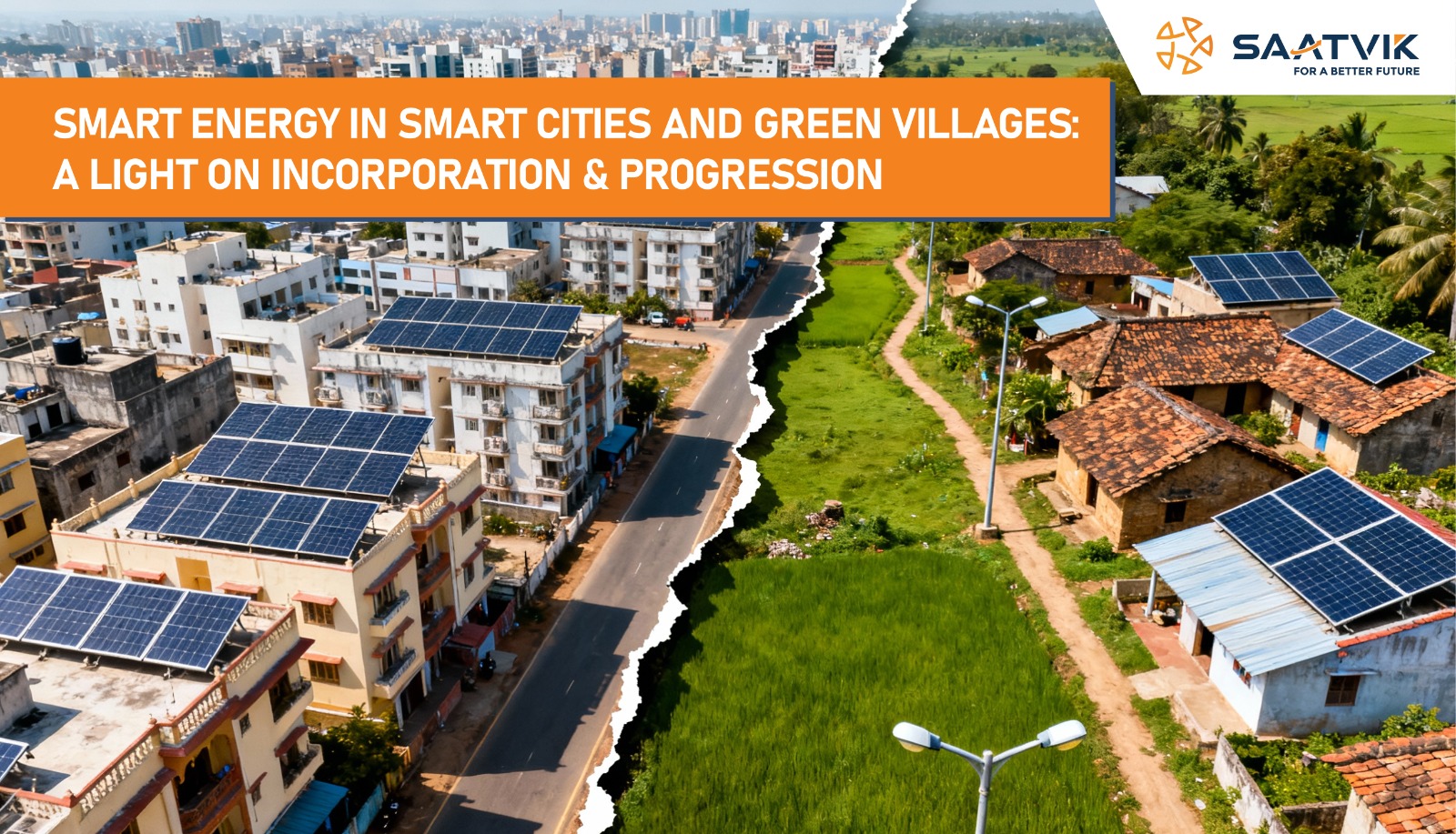
Solar energy in smart cities and green villages is no longer a futuristic vision, but an urgent need in the present time across India, to form a cleaner and greener future. With this step, India is building energy-laden infrastructure that supports sustainable development. Embracing this solar transition revolutionises both urban and rural life.
The rise of solar pave the way for a sustainable future as it is more than just a source of clean energy. It is powering everything right from the skyscraper buildings to the rural settlements in villages. Let’s embrace it and know what it can do in our lives and how the Indian government is playing their part in promoting the same for a shared vision of net carbon emissions.
The Rise of Solar Energy in Smart Cities
Smart city projects thrive on technology-laden infrastructure that always demands efficient, green, and cost-effective energy. Solar energy in smart cities not only ensure sustainability but also cuts down the dependence on conventional sources. Solar energy for streetlights, smart grids, and public transportation has become an essential piece of smart urban planning.
Green Villages Solar Integration
Green Villages are a classic how solar energy can lead towards a better future by transforming lives. With rural solar electrification, remote areas can now enjoy endless power for necessities like lighting, irrigation, and communication. Solar solutions, like on-grid solar inverter and solar pumps, are cost-effective alternatives for a better future.
Merging Solar Energy In Smart Cities & Green Villages: Technological Advancements
Technological advancement is pivotal while moving forward to incorporate solar energy in smart cities and green villages. These advancements will focus on increasing the affordability, efficiency, and scalability of the entire solar power system.
Solar Integration in Building Design
The architectural integration of solar panels in a building known as BIPV (Building integrated photovoltaics) has gained too much traction. A lot of research has going on to find materials, techniques, and designs to effortlessly merge solar with building facades, roofing, and window material. This advancement improves the energy generation by keeping up the aesthetic appeal.
Smart Grid Integration
Fusing solar energy with smart grid systems enables energy distribution, load management, and demand response. The procedure of developing advanced algorithms and control systems to optimize the integration with smart grids. This will help in balancing energy supply and demand, refining grid stability, and enabling effective management of renewable energy resources.
Data Analytics and AI
AI and Data Analytics emerged as powerful tools for optimizing solar energy usage. The latter one got used in inspecting energy generation patterns, weather forecasts, and energy utilization data. On the other hand, the AI can predict and optimize energy production and consumption, leading to maximizing the efficiency and impact of solar energy in smart cities and green villages.
Economic & Environmental Alterations
It is proven that involving solar energy in smart cities can lead to various economic and environmental benefits. It reduces carbon emissions, improves air quality, and generates more jobs in the renewable energy sector. Moreover, solar panels and installation prices are becoming low, making it accessible for cities and village residents.
Government Schemes For Promoting Solar Energy In Smart Cities & Green Villages
Indian Government, with a clear and strong vision, i.e., 500 GW of renewable energy capacity till 2030 moving ahead wisely. To fulfil this, they laid down several policies regarding solar energy. These are:
PM KUSUM (Pradhan Mantri Kisan Urja Suraksha Evam Utthaan Mahabhiyan)
This scheme is released to promote the adoption of solar pumps and panels in rural areas. As of 31 March 2024, 166 MW decentralized solar capacity has already been installed. On top of that, 3.26 lakhs agricultural pumps have also been solarized under this scheme.
PLI (Production Linked Scheme) for High Efficiency Solar (PV) Modules
Released to attain the manufacturing capacity of PV modules with an outlay of ₹24,000 crore.
PM Surya Ghar Yojana
Muft Bijli Yojana is a central scheme aiming to install rooftop solar panels in one crore households with a financial cap of ₹75,021 crore till FY27. It is expected to do the installation of 30 GW residential rooftop solar and 40-45 GW of overall rooftop solar capacity addition by FY27.
New Solar Power Scheme (For Particularly Vulnerable Tribal Groups (PVTG) Villages)
Launched on 4th January 2024 under the Pradhan Mantri Janjati Adivasi Nyaya Maha Abiyan for the electrification of one lakh un-electrified PVTG households. These households are in 18 states and one union territory by the provision of off-grid solar systems. It is for those areas where grid availability is not feasible.
Solar Parks Scheme
To offer solar power developers a plug-and-play model by providing the necessary infrastructure with all clearances. It states the sanctioned capacity of 39.7 GW for the development of 56 solar parks in 13 states. Solar project with the capacity of 11.59 GW has already been commissioned, and the remaining capacity is in implementation.
CPSU (Central Producer Sector Undertaking) Phase-II
Came into existence to set grid-connected solar PV projects by PSUs and the government organizations, leveraging domestic PV cells and modules, with VGF support for self-usage or for government bodies. Out of the total 8.2 GW capacity of Solar PV power plants, around 1.66 GW capacity has already been commissioned, and the balance is under implementation as of March 2024.
The Road Ahead: Solar Energy in Smart Cities & Green Villages
India’s solar transition is a journey filled with progress that promises unmatched transformation. Like water, electricity, or energy is the primary need for everyone, and it is their right that they receive it. Decentralized systems empower all the communities and towns by providing energy independence. Villages that are remotely veiled till now can shine brighter like a smart city.
Empowering the nation, whether its smart cities or green villages, with Solar energy showcase India’s commitment to walk firmly towards net zero carbon emissions. It’s just a beginning; the real developed energy independent nation is in the making.
Winding Up
Solar energy in smart cities and green villages is a game-changer for a sustainable future. With India’s clear vision and the mission, we are on, the impact is clearly visible. By embracing cleaner energy, we are on our way to making this world a better and greener place.
Ready to harness the endless power of the sun? Get in touch with our team to start your cleaner journey today.
FAQs (Frequently Asked Questions)
1. Why is solar energy needed for urban planning?
Solar energy is a must for urban planning as it incorporates clean energy with city infrastructure, assist smart grid technology, and help in cutting down carbon emissions while fulfilling all the energy needs.
2. In what way do solar solutions support the progress of both smart cities and green villages?
Solar solutions like rooftop panels, microgrids, GTI solar inverter, and solar-powered infrastructure can simultaneously serve smart cities and villages, leading to energy efficiency and easy clean energy access.
3. What should we call a solar smart city?
A solar smart city project known for the integration of solar energy seamlessly with smart technologies like smart grids and IoT based sensors to form an efficient and sustainable future.
This approach will enhance energy independence, reduce costs, increase air quality, and make the nation more resilient to frequent power outages.
4. What are the benefits of a solar-powered village in India?
Solar-powered villages in India benefit from uninterrupted electricity, diminished energy costs, and independence from grids. It completely supports education, healthcare, and farming with the help of solar water pumps and microgrids.

Comments
Sorry, Comments are closed!